


Views: 0 Author: Site Editor Publish Time: 2026-10-15 Origin: Site


Flexible packaging engineers often assume bumping up the optical density (OD) of a metallized substrate automatically delivers a proportional barrier improvement. You might think a thicker aluminum layer blocks more oxygen, moisture, and light, extending shelf life. Field experience proves otherwise. The relationship between metal thickness and barrier performance hits a wall of diminishing returns quickly. Over-specifying OD to chase tiny barrier gains creates massive headaches on the converting floor. Pushing metal deposition too far introduces mechanical vulnerabilities. You get poor lamination bond strength, metal transfer to the sealant web, and severe flex cracking during transport. These failures destroy package integrity faster than a lower initial barrier spec would. We need a practical framework to evaluate optical density, metal layer uniformity, and substrate surface energy. This lets you specify the right packaging material for actual shelf-life requirements without over-engineering the structure and causing downstream machine faults.
OD is Logarithmic, Not Linear: Because the optical density scale is logarithmic, the difference in light transmission—and corresponding barrier improvement—plateaus significantly at higher values.
The Threshold of Diminishing Returns: For most substrates (like BOPP or PET), pushing OD beyond standard functional thresholds (typically 2.5 to 3.0) yields negligible improvements in Oxygen Transmission Rate (OTR) and Moisture Vapor Transmission Rate (MVTR).
High OD Introduces Mechanical Risks: Excessively thick aluminum deposition increases the risk of metal crazing, loss of lamination bond strength, and barrier degradation during handling.
Uniformity Outperforms Raw Thickness: A lower OD with superior metal nucleation and uniform deposition provides a more reliable barrier than a high OD with microscopic pinholing or poor substrate adhesion.
Optical Density (OD) is a logarithmic measurement of light transmission through a material. In metallized packaging films, OD indicates how effectively the deposited aluminum layer blocks light. Higher OD values mean lower light transmission.
Optical Density (OD) | Light Transmission | Light Blocked |
|---|---|---|
1.0 | 10% | 90% |
2.0 | 1% | 99% |
3.0 | 0.1% | 99.9% |
OD can also provide an indirect indication of aluminum coating thickness. However, the relationship varies with coating structure, substrate properties, and measurement conditions.
Higher OD does not automatically guarantee better oxygen or moisture barrier performance. Packaging manufacturers should also evaluate OTR, WVTR, coating uniformity, and metal adhesion.
Explore our Metallized PET Film for flexible packaging applications requiring light protection and barrier performance.
Optical density measurement helps manufacturers monitor aluminum coating consistency during vacuum metallization. Offline densitometers measure OD at selected film positions, while inline monitoring systems can provide continuous data across the film width.
Consistent OD depends on evaporation rate, web speed, vacuum conditions, and substrate quality.
Key quality checks include:
Instrument Calibration: Verify densitometer accuracy using suitable reference standards.
Coating Uniformity: Measure OD across the film width to identify variations.
Process Monitoring: Check vacuum pressure, evaporation conditions, and web speed.
Surface Inspection: Identify pinholes, coating defects, or adhesion problems.
Barrier Verification: Test OTR and WVTR to confirm required packaging performance.
These checks help maintain consistent metallization quality and reduce potential converting problems.
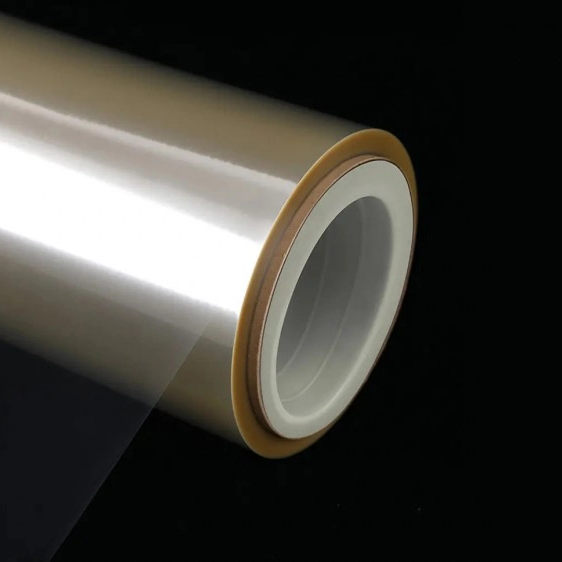
Optical density (OD) measures how effectively a metallized film blocks transmitted light. Higher OD generally indicates a denser or thicker metal coating, but it does not always guarantee better oxygen or moisture barrier performance. Coating uniformity, substrate properties, and microscopic defects also influence the final results.
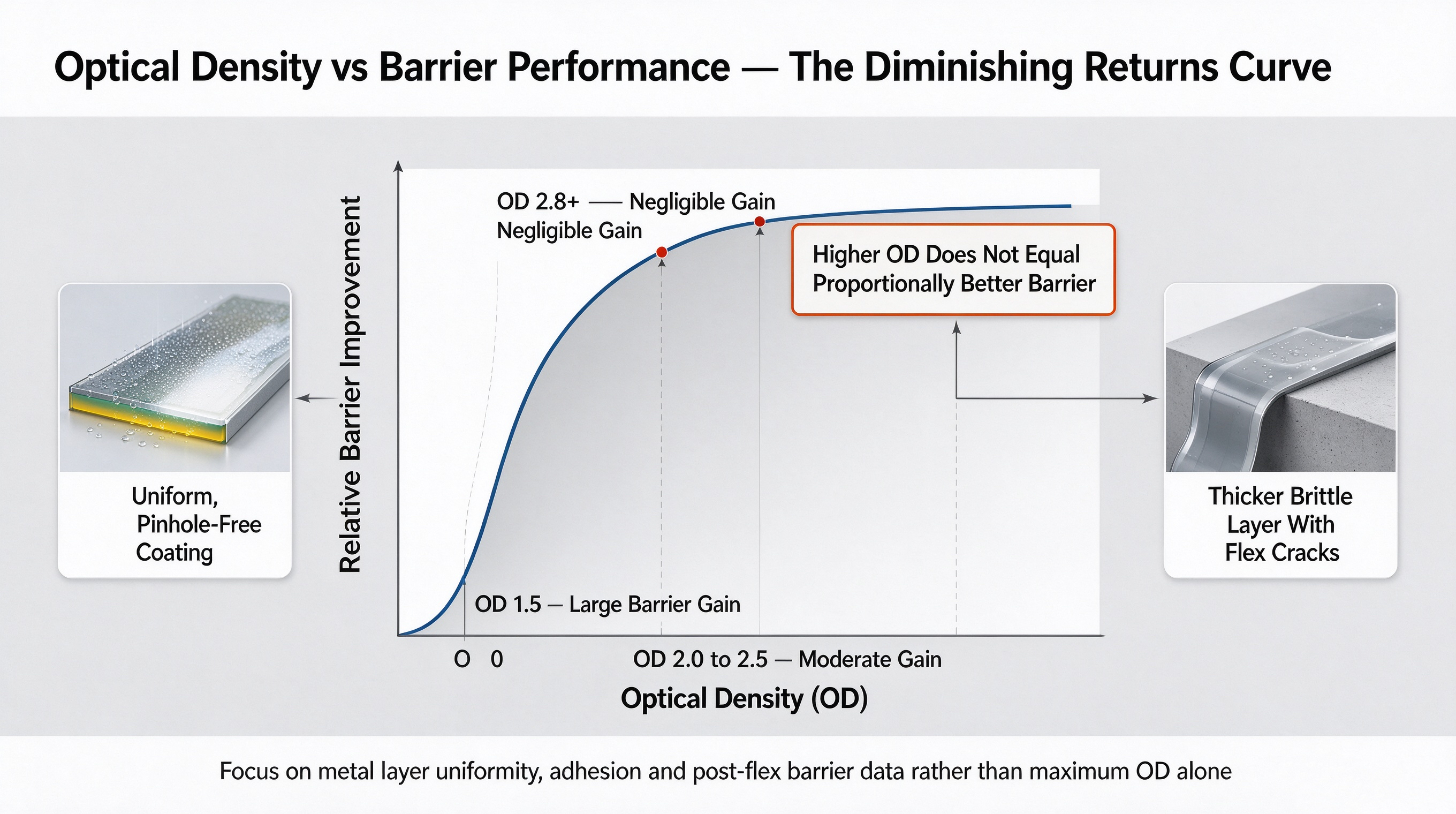
Increasing optical density in metallized films generally improves light blocking and may enhance barrier performance. However, higher OD does not always produce proportional reductions in oxygen or moisture transmission.
Once the metal coating provides sufficient coverage, further improvements may be limited by pinholes, coating defects, and substrate characteristics. Therefore, manufacturers should balance OD specifications with actual barrier requirements.
OTR (Oxygen Transmission Rate) and WVTR (Water Vapor Transmission Rate) measure the resistance of packaging films to oxygen and moisture transmission.
Although higher optical density can improve barrier performance, the relationship depends on coating quality, film structure, and processing conditions. Buyers should evaluate tested OTR and WVTR values rather than relying on OD alone.
For demanding packaging applications, explore our High Barrier Metallized PET Film.
Optical density directly relates to light transmission. Higher OD values indicate lower transmitted light intensity at the measured wavelength.
Metallized films can help protect light-sensitive products such as coffee, dairy powders, and certain pharmaceutical products. However, UV protection should be evaluated using wavelength-specific transmission data rather than OD alone.
Excessively high metallized film optical density may increase manufacturing costs and introduce processing challenges without delivering meaningful barrier improvements.
Metal adhesion affects the durability of metallized films during printing and lamination.
Poor substrate treatment, unsuitable coating conditions, or excessive internal stress may weaken adhesion between the aluminum coating and the base film. This can lead to metal transfer or delamination during subsequent processing.
Metallized barrier films experience bending, folding, and stretching during packaging conversion and transportation.
Mechanical stress may create microscopic cracks or defects in the metal coating, reducing oxygen and moisture protection. Film flexibility and coating integrity should therefore be evaluated alongside optical density.
Higher OD specifications may require additional coating material or adjustments to metallization conditions, potentially increasing production costs.
For many packaging applications, a consistent coating with verified barrier performance provides better value than simply selecting the highest available OD.
Selecting suitable metallized packaging film requires evaluating substrate compatibility, coating uniformity, and application-specific barrier requirements.
Surface treatment influences metal adhesion and coating uniformity.
PET, BOPP, and CPP substrates have different surface characteristics. Corona, plasma, or other suitable treatments can improve surface conditions for metallization.
Appropriate substrate preparation helps support consistent coating quality and reliable converting performance.
Coating uniformity is often more important than achieving an exceptionally high average OD.
Pinholes, scratches, and uneven aluminum deposition may reduce barrier performance even when the reported optical density is high.
Buyers should request information on OD consistency, coating adhesion, and tested OTR/WVTR values.
Different packaging products require different combinations of light, oxygen, and moisture protection.
Application | Recommended Film Consideration | Primary Requirement |
|---|---|---|
Snack Foods | Metallized BOPP or PET | Moisture and light protection |
Confectionery | Metallized BOPP or CPP | Moisture resistance |
Coffee Packaging | High Barrier Metallized PET | Oxygen, moisture, and aroma protection |
Pharmaceutical Packaging | Validated high-barrier structures | Product-specific stability requirements |
Chemical Packaging | Compatible high-barrier laminates | Moisture and chemical resistance |
Specific OD targets should be determined through barrier testing, packaging trials, and shelf-life requirements rather than fixed application-wide values.
Explore our Metallized PET Film for different flexible packaging applications.
Metallized film quality testing should evaluate optical density, barrier properties, coating adhesion, and mechanical durability. Testing under relevant processing conditions helps identify potential problems before commercial production.
Recognized testing methods help manufacturers verify oxygen and moisture transmission performance.
Test Standard | Measurement | Main Purpose |
|---|---|---|
ASTM D3985 | OTR | Measures oxygen transmission using a coulometric sensor |
ASTM F1249 | WVTR | Measures water vapor transmission using an infrared sensor |
ASTM F1927 | OTR | Evaluates oxygen transmission under controlled humidity |
Buyers should compare results obtained using equivalent measurement units, test conditions, and sample structures.
Metallized film adhesion and barrier performance should be verified after converting and lamination, especially when films undergo repeated bending or mechanical stress.
A practical validation process includes:
Check coating uniformity: Measure OD consistency across the film.
Evaluate metal adhesion: Use an appropriate adhesion test.
Conduct lamination trials: Verify compatibility with selected adhesives and substrates.
Assess mechanical durability: Examine coating integrity after bending or flexing.
Verify final barrier performance: Measure OTR and WVTR after relevant converting processes.
These checks help determine whether the selected metallized film can maintain its required barrier properties throughout packaging production and use.
Request technical data sheets detailing both OD tolerances and flex-tested barrier properties from your film supplier.
Initiate pilot runs to test lamination bond strength and metal transfer before approving any high-OD film for full-scale commercialization.
Audit your substrate surface energy specifications to ensure incoming raw films meet the minimum dyne levels required for dense metal nucleation.
Implement inline optical density monitoring on your metallization equipment to catch cross-web uniformity issues in real time.
A: Typical optical density ranges fall between 2.0 and 2.8, depending on the application and base substrate. Standard snack food packaging using BOPP usually targets 2.0 to 2.5. More demanding applications, such as coffee or medical pouches using PET, often target 2.5 to 2.8.
A: Higher optical density requires depositing more aluminum, which consumes more raw aluminum wire. It also necessitates running the vacuum metallizer at slower web speeds to allow sufficient metal accumulation. This reduces overall machine throughput and efficiency on the production floor.
A: Yes. Excessively high optical density creates a thick, brittle metal layer with high internal stress. This leads to metal crazing, poor adhesion to the base substrate, and severe lamination bond failure. The thick aluminum layer separates from the polymer web during converting processes.
A: Optical density is a unitless, logarithmic measure of how much light is absorbed or blocked by the film. Metal thickness is a physical measurement, usually in angstroms, of the actual aluminum layer. OD correlates to thickness, but it is not a direct physical measurement.
A: No. While a thicker metal layer occasionally covers minor substrate defects, increasing OD is an inefficient way to solve pinholing. You eliminate pinholes by ensuring substrate cleanliness, optimizing surface energy dyne levels, and maintaining stable vacuum chamber conditions during the metallization process.


