


Views: 0 Author: Site Editor Publish Time: 2026-10-15 Origin: Site


Flexible packaging failures routinely stem from mismatched barrier properties. These miscalculations result in compromised shelf life, loss of aroma and flavor, product recalls, and severe brand damage. Packaging engineers and procurement teams frequently face ambiguous or idealized Technical Data Sheets (TDS). Misinterpreting these metrics leads to either over-engineering, which wastes budget on unnecessary barrier levels, or under-specifying, which risks catastrophic product spoilage on the retail shelf.
Decoding the relationship between OTR vs WVTR is necessary to align material capabilities with specific product preservation requirements. Environmental realities dictate how a package performs outside the laboratory. You must accurately evaluate both Oxygen Transmission Rate and Water Vapor Transmission Rate to ensure your packaging structure survives the supply chain and protects the product until consumption.
The Golden Rule of Barrier Data: On a technical data sheet, lower OTR and WVTR values indicate a stronger barrier and better protection.
Distinct Mechanisms: OTR measures oxygen permeation, while WVTR measures moisture permeation; a material highly resistant to one may offer zero protection against the other.
Context is Critical: Data sheet values are useless without knowing the exact testing conditions (temperature and relative humidity), as environmental factors drastically alter permeation rates.
Converting Impacts Performance: The theoretical OTR and WVTR of a flat film will degrade once printed, laminated, folded, and sealed into a final package.
Cost-to-Performance Ratio: Selecting the right barrier film requires balancing strict shelf-life requirements against material costs, machinability, and sustainability mandates.
OTR (Oxygen Transmission Rate) and WVTR (Water Vapor Transmission Rate) are two essential indicators for evaluating flexible packaging barrier performance. Both measure how effectively packaging materials resist gas or moisture transmission, helping manufacturers select suitable films for product protection and shelf-life requirements.
OTR measures the amount of oxygen passing through a film over a specified area and time under controlled conditions. It is commonly expressed in cm³/m²/24h. Lower OTR values indicate stronger oxygen barrier performance when measured under comparable conditions.
Low-OTR films help protect oxygen-sensitive products such as coffee, nuts, meat, and certain pharmaceuticals against oxidation.
For demanding packaging applications, explore our High Barrier Metallized PET Film, designed to provide enhanced oxygen, moisture, and light protection.
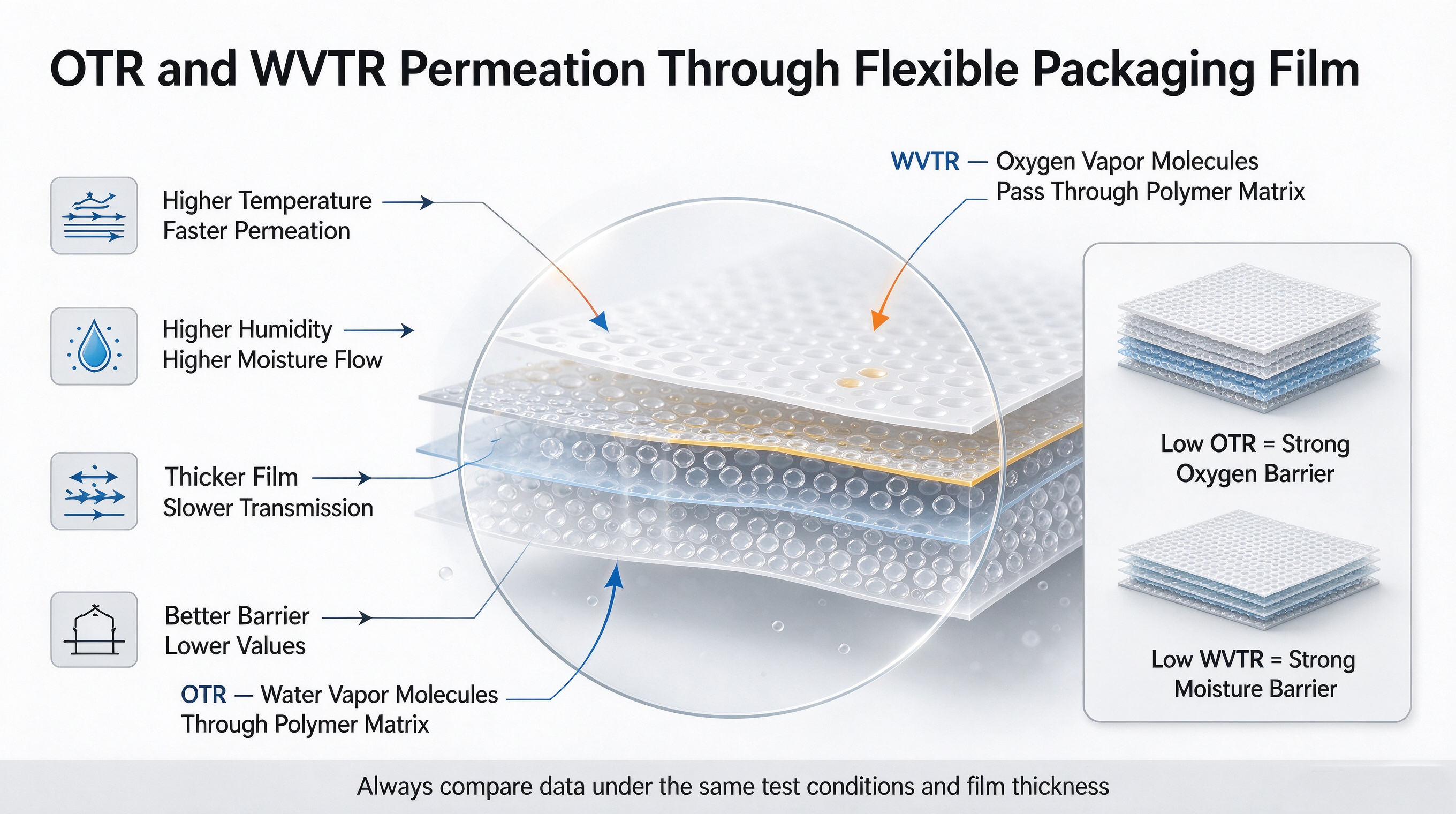
WVTR measures the amount of water vapor passing through a film over a specified area and time. It is commonly expressed in g/m²/24h. Lower WVTR values indicate better moisture resistance under equivalent testing conditions.
Low-WVTR films are important for dry foods, powdered products, electronics, and moisture-sensitive packaging. They help reduce unwanted moisture absorption or loss during storage and transportation.
Oxygen and moisture barrier performance depend on different material properties. For example, EVOH provides excellent oxygen resistance under dry conditions but is sensitive to humidity. Polyethylene and polypropylene generally offer good moisture resistance but comparatively limited oxygen protection.
Multilayer structures and barrier coatings can combine these properties to achieve more balanced protection.
For transparent packaging applications, explore our High Barrier AlOx Coated Film, which offers oxygen and moisture protection while maintaining product visibility.
Barrier film technical data sheets (TDS) provide information about oxygen transmission, moisture transmission, mechanical properties, and testing conditions. Buyers should compare these specifications carefully to ensure that different films meet the same application requirements.
OTR and WVTR testing follows established methods that help manufacturers evaluate barrier performance consistently.
Test Standard | Measurement | Testing Method |
|---|---|---|
ASTM D3985 | OTR | Coulometric sensor |
ASTM F1927 | OTR | Coulometric sensor under controlled humidity |
ASTM F1249 | WVTR | Modulated infrared sensor |
ASTM E96/E96M | WVTR | Gravimetric method |
When comparing films, buyers should verify the test standard, measurement units, temperature, humidity, and relevant test parameters.
OTR and WVTR values change with temperature and humidity. Higher temperatures often increase permeation, while humidity can significantly affect moisture-sensitive polymers such as EVOH.
Packaging manufacturers should request barrier data measured under conditions relevant to their actual storage, transportation, and product requirements.
Film thickness influences barrier performance, particularly in homogeneous polymer films. Increasing thickness generally reduces transmission rates, but coated and multilayer films may behave differently because coating integrity and layer structure also affect permeability.
Buyers should compare films at equivalent thicknesses and testing conditions whenever possible.
Barrier performance alone does not determine whether a film is suitable for packaging production. Mechanical strength, flexibility, and converting compatibility are also important.
Technical Property | Why It Matters |
|---|---|
Tensile Strength | Resistance to stretching and damage |
Puncture Resistance | Protection against physical damage |
Coefficient of Friction (COF) | Smooth operation on packaging machines |
Heat Shrinkage | Dimensional stability during processing |
Surface Tension | Printing and lamination compatibility |
Coating Adhesion | Barrier layer durability during converting |
For metallized or oxide-coated films, buyers should also evaluate coating uniformity and barrier performance after lamination or flexing.
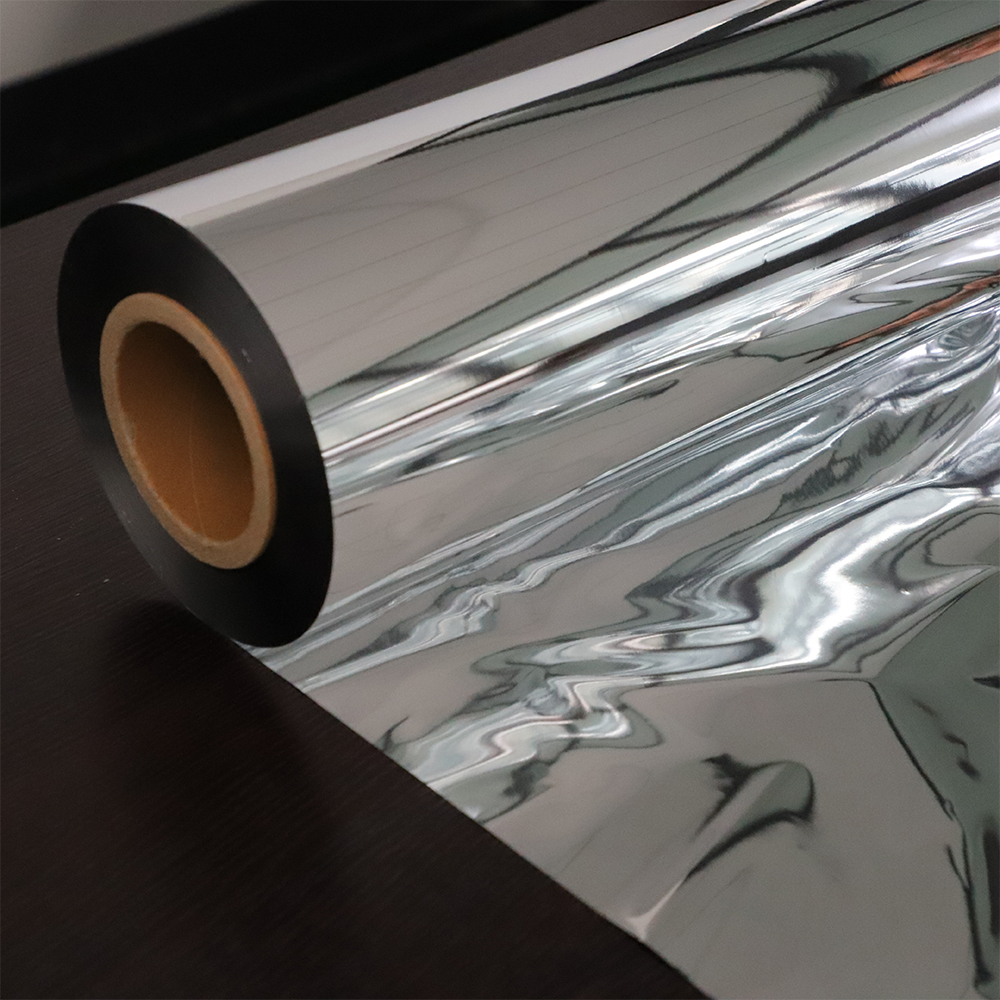
High barrier packaging films protect products against oxygen, moisture, and light. Different materials provide different barrier properties, so packaging manufacturers often combine multiple layers to meet shelf-life and processing requirements.
Material | Oxygen Barrier | Moisture Barrier | Typical Applications |
|---|---|---|---|
EVOH | Excellent in dry conditions | Limited | Meat and cheese packaging |
PVdC | Good to excellent | Good | Food and pharmaceutical packaging |
Nylon (PA) | Moderate to good, humidity-dependent | Limited | Thermoformed packaging |
HDPE / PP | Limited | Good | Dry foods and flexible packaging |
Metallized PET | High | High | Coffee, snacks, pet food |
Aluminum Foil | Extremely high when defect-free | Extremely high when defect-free | Pharmaceuticals, sensitive foods |
AlOx / SiOx Coated Films | High, coating-dependent | Good to high, coating-dependent | Transparent barrier packaging |
Barrier performance varies with film thickness, coating quality, humidity, and testing conditions.
EVOH film provides excellent oxygen resistance under low-humidity conditions but loses barrier performance as moisture exposure increases. It is commonly incorporated into multilayer structures with protective polyolefin layers.
PVdC offers resistance to both oxygen and moisture, while nylon contributes mechanical strength, puncture resistance, and moderate oxygen protection. Material selection depends on packaging conditions and required shelf life.
HDPE and polypropylene films offer good moisture resistance but relatively limited oxygen protection. They are commonly used for dry food packaging and as structural or sealing layers in multilayer packaging.
For enhanced barrier performance, metallization can improve resistance to oxygen and moisture. Explore our Metallized PET Films for flexible packaging applications.
Metallized films use a thin aluminum coating to improve oxygen, moisture, and light protection. Aluminum foil provides extremely high barrier performance when intact, while transparent AlOx and SiOx coatings offer another option for packaging requiring product visibility.
For high-barrier flexible packaging, explore our High Barrier Metallized PET Film and High Barrier AlOx Coated Film.
Selecting the right barrier packaging film requires balancing oxygen and moisture protection, converting performance, cost, and recyclability. Laboratory specifications should be verified against actual packaging conditions.
OTR (Oxygen Transmission Rate) and WVTR (Water Vapor Transmission Rate) values are typically measured under controlled testing conditions. Printing, lamination, folding, and heat sealing can affect the barrier performance of finished packaging.
Manufacturers should evaluate both flat-film properties and finished-package integrity, especially for structures containing thin metallic or oxide coatings.
Higher barrier performance does not always provide better economic value. Packaging films should be selected according to product sensitivity, storage conditions, and required shelf life.
For example, moisture-sensitive dry foods may prioritize low WVTR, while oxygen-sensitive products require stronger oxygen protection. Matching specifications to actual packaging needs helps control material costs.
Recyclable high barrier packaging increasingly focuses on PE- and PP-based structures. Mono-material designs may simplify recycling compared with conventional mixed-material laminates, depending on local recycling infrastructure.
Metallized PE, BOPP, and compatible barrier coatings can support certain recyclable packaging designs. However, recyclability must be evaluated for the complete finished structure, including adhesives, coatings, and sealant layers.
Evaluation Factor | What to Consider |
|---|---|
Oxygen Protection | OTR and product sensitivity to oxidation |
Moisture Protection | WVTR and storage humidity |
Processing Performance | Lamination, forming, and heat sealing |
Material Cost | Required barrier level and packaging budget |
Sustainability | Material compatibility and recycling infrastructure |
Oxygen and moisture transmission rates operate as independent variables within polymer science. You must evaluate these metrics strictly in the context of specific environmental conditions and precise product sensitivities. Relying on generalized claims of high barrier performance leads directly to packaging failures and financial loss.
The decision framework requires systematic execution. Define the exact product failure modes, distinguishing clearly between oxidation and moisture degradation. Determine the required shelf life and map the anticipated storage conditions across the supply chain. Compare supplier data sheets using identical ASTM standards and normalized testing environments. Apply a safety factor to account for the inevitable barrier loss that occurs during printing, laminating, and heat sealing.
Take the following actions to secure your packaging specifications:
Request physical material samples and conduct internal Gelbo flex testing to simulate supply chain abuse.
Demand converted-package test data from your suppliers, rejecting evaluations based solely on flat, unblemished films.
Consult with a packaging engineer to run accelerated real-world shelf-life simulations inside environmental chambers.
Audit your current packaging portfolio to identify over-engineered structures that offer immediate cost-reduction opportunities.
A: A good value depends entirely on the product. Highly sensitive items like roasted nuts, fresh meats, and coffee require values below 1 cc/m²/day to prevent rapid oxidation. Conversely, fresh produce requires highly permeable films, often exceeding 10,000 cc/m²/day, to allow the vegetables to respire and prevent anaerobic decay.
A: Yes. Polymer polarity dictates this behavior. EVOH and Nylon are highly polar materials, making them excellent barriers against non-polar oxygen gas. However, their polar nature causes them to absorb water molecules readily. Unprotected EVOH performs exceptionally well against oxygen but offers very little resistance to moisture transmission.
A: Increased temperature accelerates permeation rates. Heat adds thermal energy to the polymer matrix, increasing polymer chain mobility. This movement creates larger free volume spaces between the molecules, allowing both gas and moisture vapor to pass through the material much faster. Permeation increases exponentially as temperatures rise.
A: There is no difference. Moisture Vapor Transmission Rate (MVTR) and Water Vapor Transmission Rate (WVTR) are interchangeable terms used to describe the exact same metric. Both terms refer to the mass of water vapor that passes through a specific area of a material over a 24-hour period.
A: Converting subjects the film to severe mechanical stress. Folding, creasing, and stretching the material over forming collars creates microscopic fractures in brittle barrier layers like foil or metallization. Additionally, oxygen and moisture can permeate laterally through the heat seal areas, bypassing the primary film barrier entirely.


