


Views: 0 Author: Site Editor Publish Time: 2026-10-15 Origin: Site


Metal transfer in metallized film is a common lamination defect that occurs when the thin aluminum coating separates from its polymer substrate and transfers to another layer of the laminate.
This problem can reduce bond strength, damage the metallic appearance, and compromise oxygen and moisture barrier performance. For flexible packaging manufacturers, understanding the causes of metal transfer is essential for maintaining consistent production quality.
This guide explains why metal transfer occurs, how to identify it, and what manufacturers can do to prevent defects during lamination.
Metal transfer occurs when the adhesion between the aluminum coating and the base film becomes insufficient to withstand lamination or subsequent mechanical stress.
Metallized packaging films typically consist of a polymer substrate, such as PET, BOPP, or CPP, with a thin aluminum layer deposited through vacuum metallization.
During lamination, the metallized surface is bonded to another film using an adhesive. If the metal-to-substrate bond is weaker than the forces applied during converting, part of the aluminum coating may separate from the original film.
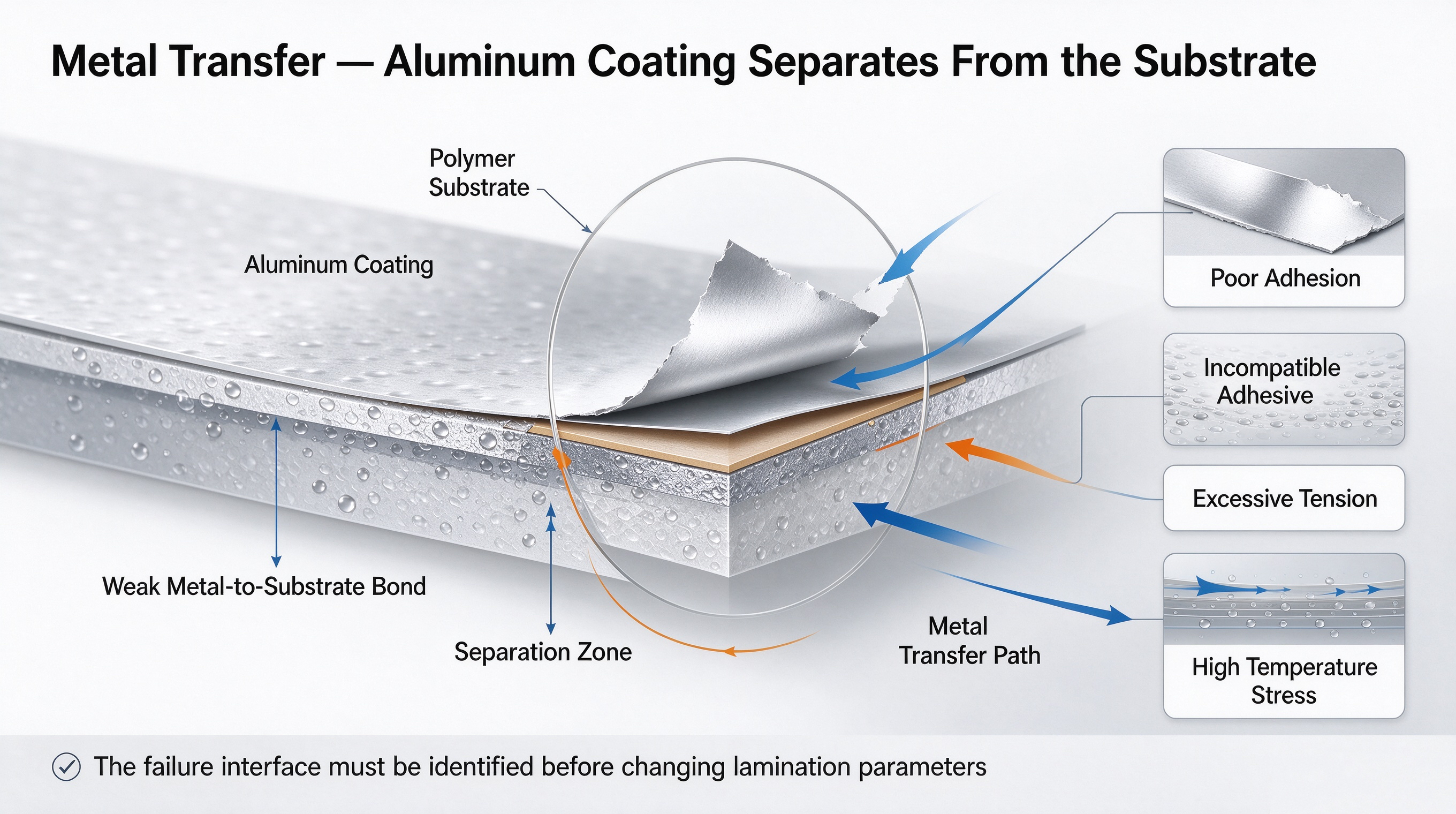
Although related, metal transfer and delamination are not identical.
Metal Transfer: The aluminum coating separates from its original substrate and may remain attached to the adhesive or another film.
Delamination: Two layers within a laminated structure separate because of insufficient bonding or material failure.
Metal transfer is one possible cause or failure mode of laminate delamination.
Several factors can contribute to metallized film metal adhesion failure, including substrate preparation, adhesive compatibility, processing temperatures, and mechanical stress.
Insufficient adhesion between the aluminum coating and the polymer film is a major cause of metal transfer.
Substrate contamination, unsuitable surface treatment, or inconsistent metallization conditions can weaken the coating interface.
Prevention: Select metallized films with consistent surface quality and verified metal adhesion. Suitable corona treatment, chemical priming, or other surface treatments may improve coating adhesion when properly specified.
Lamination adhesives must be compatible with the metallized surface and the intended packaging structure.
Unsuitable adhesive chemistry, incorrect mixing ratios, or incomplete curing may contribute to weak bonding, metal transfer, or delamination.
Prevention: Conduct adhesive compatibility testing and pilot lamination trials before full-scale production. Verify adhesive coating weight, curing conditions, and final bond strength.
Metallized films contain a thin metal coating that may be damaged by excessive stretching, folding, or uneven tension.
During lamination, unsuitable unwind tension, nip pressure, or rewinding conditions can introduce stress into the film structure.
Prevention: Maintain stable web tension, appropriate nip pressure, and consistent film alignment throughout the converting process.
Excessive temperatures may cause substrate deformation or additional stress between the polymer and aluminum coating.
Conversely, insufficient temperature or unsuitable curing conditions may affect adhesive wetting and bond development.
Prevention: Adjust lamination temperatures according to the substrate, adhesive formulation, and equipment specifications.
Optical density (OD) indicates the light-blocking characteristics of a metallized coating, but higher OD does not automatically guarantee better barrier performance.
Coating defects, uneven aluminum deposition, and unsuitable metallization conditions can affect metal adhesion and converting performance.
Prevention: Evaluate coating uniformity, metal adhesion, and actual OTR/WVTR performance rather than selecting films based only on optical density.
Metal transfer in flexible packaging may affect appearance, structural integrity, and product protection.
The aluminum layer helps improve the resistance of metallized films to oxygen and water vapor.
When the coating becomes damaged or discontinuous, the finished packaging may experience higher OTR (Oxygen Transmission Rate) and WVTR (Water Vapor Transmission Rate).
The extent of the change depends on coating damage, laminate structure, and processing conditions.
Metal separation can weaken the interface between laminated layers, increasing the risk of delamination during package forming, filling, and transportation.
Metal transfer may produce uneven metallic appearance, visible patches, or coating defects.
Severe failures can increase production waste, interrupt converting operations, and reduce the consistency of finished packaging.
Manufacturers should evaluate coating adhesion before lamination and inspect the completed structure after converting.
| Testing Method | Main Purpose |
|---|---|
| Visual Inspection | Identify coating defects and metal transfer |
| Tape Adhesion Test | Screen metal adhesion to the base film |
| Lamination Bond Test | Evaluate bond strength and failure location |
| OTR Testing | Measure oxygen barrier performance |
| WVTR Testing | Measure moisture barrier performance |
| Flex Testing | Assess coating durability under mechanical stress |
Tape adhesion tests can provide a practical screening method for evaluating coating attachment.
However, results depend on the test procedure, tape properties, and film structure. Buyers should use agreed testing methods and acceptance criteria.
Peel or bond-strength testing helps determine whether separation occurs within the adhesive, at the metal coating, or between the aluminum and polymer substrate.
Identifying the failure interface is important for selecting the correct preventive action.
Barrier testing helps determine whether the lamination process has affected the film's oxygen and moisture resistance.
Common methods include ASTM D3985 for OTR and ASTM F1249 for WVTR.
Testing should use comparable conditions and relevant finished-laminate samples.
Preventing metal transfer requires coordinated control of film quality, adhesive selection, and lamination conditions.
Film selection is the first step.
Manufacturers should evaluate substrate quality, coating uniformity, metal adhesion, and barrier properties before production.
For high-barrier flexible packaging, our High Barrier Metallized PET Film is designed with attention to coating uniformity, adhesion, and oxygen and moisture resistance.
Choose an adhesive suitable for the metallized surface, secondary substrate, and intended packaging application.
Verify adhesive mixing, coating weight, curing requirements, and final bond performance through production trials.
Maintain appropriate processing conditions to reduce stress on the metal coating.
Important parameters include:
Web Tension: Avoid excessive stretching and uneven tension.
Nip Pressure: Maintain consistent pressure for reliable bonding.
Temperature: Follow substrate and adhesive processing requirements.
Curing: Allow sufficient time for the adhesive to develop its intended properties.
Rewinding: Prevent excessive roll pressure and film distortion.
Raw film specifications alone may not represent the performance of the finished laminate.
Manufacturers should evaluate coating adhesion, bond strength, and barrier properties after relevant converting processes.
For additional metallized packaging options, explore our Metallized PET Films.
| Problem | Possible Cause | Recommended Action |
|---|---|---|
| Aluminum separates from PET | Weak metal-to-substrate adhesion | Review surface treatment and film quality |
| Metal transfers during peeling | Adhesive bond exceeds coating adhesion | Evaluate adhesive compatibility and coating strength |
| Laminate develops wrinkles | Excessive or uneven web tension | Adjust tension and web alignment |
| Bond strength remains low | Incomplete curing or adhesive issues | Review mixing, coating weight, and curing |
| Barrier performance declines | Coating defects or mechanical damage | Test finished OTR/WVTR and coating integrity |
The most effective corrective action depends on identifying the actual failure interface rather than changing multiple production parameters without testing.
A reliable metallized film supplier should provide consistent product quality and technical information to support downstream converting.
Packaging manufacturers should evaluate:
Metal adhesion: Consistent coating attachment to the substrate.
Optical density: Uniform OD across the film width.
Barrier properties: Verified OTR and WVTR specifications.
Surface treatment: Compatibility with intended lamination processes.
Customization: Suitable thickness, width, and coating specifications.
Technical support: Assistance with material selection and performance evaluation.
Selecting suitable film materials helps reduce avoidable converting defects and supports more consistent production.
Metal transfer in metallized film can result from poor coating adhesion, incompatible adhesives, excessive mechanical stress, or unsuitable lamination conditions.
Preventing this defect requires a combination of reliable metallized substrates, appropriate adhesive systems, controlled processing parameters, and finished-laminate testing.
At Zhejiang Pengyuan New Material, we provide metallized PET films and high-barrier packaging materials for flexible packaging and industrial applications.
Contact our team to discuss suitable film specifications, coating requirements, and custom metallized film solutions for your lamination projects.
Metal transfer may result from weak aluminum adhesion, incompatible adhesives, excessive web tension, unsuitable processing temperatures, or coating defects.
Not exactly. Metal transfer involves separation of the aluminum coating from its substrate, while delamination refers more broadly to separation between layers in a laminated structure.
Select films with reliable metal adhesion, verify adhesive compatibility, control lamination conditions, and conduct bond-strength testing before full production.
No. Higher OD indicates lower light transmission but does not necessarily improve coating adhesion. Metal transfer resistance depends on substrate preparation, coating quality, and lamination conditions.
Metal transfer may damage the continuity of the aluminum barrier layer, potentially increasing oxygen and moisture transmission. The actual effect should be verified through finished-laminate testing.
Metallized PET, BOPP, and CPP films may be suitable depending on processing requirements. Buyers should compare thermal stability, coating adhesion, barrier performance, and compatibility with the intended adhesive system.


